

Rise Up Patriots Conference 3.0 Calls for Renewed Patriotism, Responsible Citizenship and National Transformation


**By NASSNEWS**
The Rise Up Patriots Conference 3.0, organised by the Unveiling and Rebranding Nigeria Initiative (URNI), has called for renewed patriotism, responsible citizenship and collective commitment towards building a better Nigeria, emphasising the need for citizens, particularly young people, to move beyond criticism and become active participants in national development.
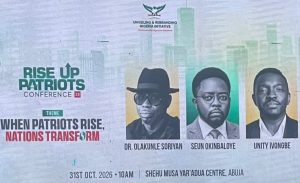

The conference, held on Saturday, October 31, 2026, at the Shehu Musa Yar’Adua Centre, Abuja, with the theme, *“When Patriots Rise, Nations Transform,”* was aimed at inspiring a new generation of Nigerians to embrace positive values, strengthen national identity, promote accountability and contribute meaningfully to the country’s growth and development.


The programme brought together thought leaders, media professionals, security representatives and other stakeholders who examined the role of patriotism, leadership, personal responsibility and national consciousness in addressing Nigeria’s challenges and shaping its future.
Delivering the keynote address, Dr. Olakunle Soriyan challenged Nigerians, particularly young people, to take responsibility for their lives and the future of the country, stressing that meaningful national transformation begins with a change in individual attitudes and mindsets.
Soriyan argued that personal development requires people to look beyond conventional ideas of right and wrong and develop the wisdom to distinguish between what is merely correct and what is necessary for progress.
He explained that religious beliefs, tribal affiliations and rigid moral assumptions could sometimes limit people’s thinking and prevent them from making decisions that address complex realities.
According to him, wisdom involves understanding the circumstances surrounding a decision and recognising when established principles must be examined in the light of practical realities.
He maintained that young Nigerians must develop independent thinking, embrace responsibility and build the capacity to navigate an increasingly complex and diverse society.
The keynote speaker further challenged participants to stop defining their future solely by their circumstances, family backgrounds or the failures of institutions, insisting that individual responsibility remains essential to personal progress.
He noted that while people could acknowledge the difficulties they experienced growing up, they must not allow past disappointments to become permanent excuses for inaction.
Soriyan urged young people to invest in their intellectual capacity, character, skills and problem-solving abilities, describing these qualities as essential tools for personal success and national development.
On national identity, he criticised the tendency of Nigerians to place ethnic, religious and regional affiliations above a shared national identity.
He argued that national unity would remain difficult to achieve if citizens continued to identify primarily with their immediate communities rather than embracing a collective sense of responsibility for the country.
He also challenged negative narratives about Nigeria, maintaining that the actions of a minority should not be used to define the character of the entire population.
According to him, although the country faces genuine challenges, the overwhelming majority of Nigerians are hardworking and committed to making meaningful contributions to society.
He urged citizens and the media to promote balanced, evidence-based narratives about the country rather than allowing negative reports to become the dominant representation of Nigeria and its people.
Speaking on corruption and insecurity, Soriyan argued that no society had completely eliminated crime, noting that the priority should be to strengthen institutions, enforce accountability and develop effective systems for managing such challenges.
He also called for a more humane understanding of the difficult conditions under which many security personnel operate, urging Nigerians to recognise the sacrifices of police officers while demanding improved welfare, dignity and accountability within the security system.
He maintained that responsible citizenship goes beyond criticising institutions and requires citizens to recognise positive conduct and contribute to solutions.
Soriyan further emphasised that pain, disappointment and failure are unavoidable aspects of life but should be treated as opportunities for reflection and necessary adjustments.
Using the illustration of an improperly positioned hand, he explained that although correcting its position might initially cause discomfort, the adjustment would eventually bring relief.
He urged participants to apply the same principle to their personal, professional and financial lives by identifying the causes of their difficulties and making deliberate changes rather than relying on temporary solutions.
He concluded by encouraging young Nigerians to take ownership of their decisions, build personal capacity and stop placing excessive expectations on government or other people, stressing that the greatest contribution individuals could make to society was to first become responsible for themselves.
Also speaking at the conference, Seun Okinbaloye, a broadcast journalist, emphasised the importance of accountability and active citizenship, encouraging Nigerians to hold public officeholders accountable and demand transparency in governance.
He stressed that citizens must not remain passive observers of the country’s political and developmental processes but should actively participate in shaping the decisions that affect their lives.
Ambassador Hassan Tukur, a patron of the Unveiling and Rebranding Nigeria Initiative, also called on Nigerians to translate their patriotism into practical actions, urging citizens to move beyond discussions and social media criticism to contribute positively to their immediate communities.
He encouraged participants to identify simple but meaningful actions they could undertake within their individual capacities to make Nigeria a better place.
Similarly, SP Orvenonne Ikwen of the Police Campaign Against Cultism and Other Vices (POCACOV) urged young Nigerians to shun drug abuse, cultism, political thuggery and other social vices capable of undermining their future and the stability of the country.
He encouraged young people to embrace discipline, responsible behaviour and positive values that would enable them to become productive members of society.
Unity Ivongbe, another speaker at the conference, was also featured on the programme alongside Dr. Olakunle Soriyan and Seun Okinbaloye.
The conference reinforced the need for Nigerians to recognise that national transformation cannot be achieved by government alone but requires the collective participation of citizens across different sectors and generations.
It also underscored the importance of responsible leadership, positive national narratives, individual accountability and a renewed commitment to the ideals of nation-building.
The programme ended with a call for Nigerians to rise above divisions, embrace their responsibilities and become active contributors to the transformation of the country, in line with the conference theme: *“When Patriots Rise, Nations Transform.”*