

OKANGA: The Representative Who Made Enone Heard
By Yemi Itodo
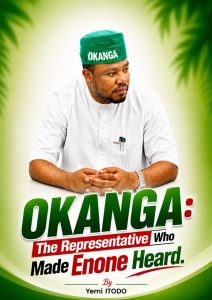

In the history of Benue State’s representation at the National Assembly, some lawmakers distinguish themselves through legislation, others through constituency projects, while a few become prominent voices on the national stage. Hon. Chief (Dr.) Philip Agbese, Member representing Ado/Okpokwu/Ogbadibo Federal Constituency, belongs to that rare category.
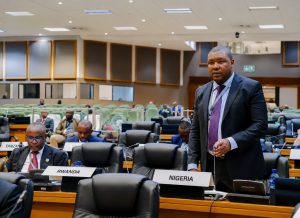
Popularly known as OKANGA (the Talking Drum), Agbese has emerged as one of the most recognisable voices of the 10th House of Representatives. His emergence as Deputy Spokesperson has placed him at the centre of the responsibility of communicating, explaining and defending the decisions, resolutions, policies and activities of the leadership and the entire House.

By Yemi Itodo
It is a responsibility he has handled with remarkable confidence.
Through television appearances, newspaper interviews, public statements and other media engagements, Agbese has consistently provided Nigerians with explanations on parliamentary decisions and responded to issues concerning the National Assembly. In doing so, he has helped bridge the communication gap between Parliament and the public.
This is why the name OKANGA has become particularly appropriate. Like the traditional talking drum, his voice carries far beyond the immediate environment.
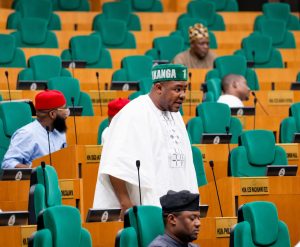

But Agbese’s influence has not been restricted to Nigeria.
Through his engagements with the Pan-African Parliament and other national and international platforms, he has contributed to projecting Nigeria’s legislative voice beyond the shores of the country. His participation in continental parliamentary affairs has also given him an opportunity to represent not just Benue, but Nigeria and its democratic institutions.
Yet, perhaps what makes his story more remarkable is that despite these national and international exploits, Agbese has not lost touch with home.
A REPRESENTATIVE CLOSE TO HIS PEOPLE
For a politician who spends much of his time in Abuja and on national platforms, Agbese remains remarkably relatable and accessible to his people.
His representation, by all indications, does not stop at the boundaries of political party affiliation. His constituents include people of different political persuasions, and he has continued to present himself as a representative for everyone.
That is an important quality in public service.
Elections may be contested along party lines, but representation should never be partisan. Once elected, the mandate belongs to the people.
Agbese appears to understand this distinction.
His accessibility and willingness to engage with people from different backgrounds have helped strengthen his relationship with the people of Enone and contributed to the growing affection for his representation.
MORE THAN A TALKING DRUM
While his media visibility has made him one of the most recognisable lawmakers from Benue, Agbese’s record should not be judged by his television appearances alone.
The primary responsibility of a legislator is legislation, representation and oversight, and he has also sought to make his mark in these areas.
Agbese has been rated as the one with the highest number of Bills and Motions standing in his name among representatives from Benue State in the 10th National Assembly. This legislative engagement provides another dimension to his representation and demonstrates that his public profile is backed by participation in the core business of Parliament.
His constituency advocacy has equally been significant.
Through his engagements with the Federal Government and various agencies, many of his constituents have benefited from employment opportunities and other interventions. Remarkably, some beneficiaries have come from other parts of Benue State and even other states of the federation.
That is another indication that Agbese’s understanding of representation goes beyond narrow geographical interests.
FROM ADVOCACY TO DEVELOPMENT
The ultimate test of political representation, however, is what the people can eventually see and feel.
On this front, Agbese has attracted interventions to Ado/Okpokwu/Ogbadibo in several critical sectors, including education, healthcare, electricity, access roads, ICT, agriculture, women and youth empowerment, among others.
These interventions matter because development is not measured only by speeches. It is measured by classrooms that improve learning, healthcare facilities that serve communities, electricity that supports economic activities, roads that connect people to markets, digital opportunities that empower young people and programmes that give women and farmers greater economic capacity.
As the 2025 and 2026 federal budgets move into implementation, many of the interventions associated with the constituency are expected to become more visible.
When the projects and programmes begin to take physical shape across Enone, the people may better appreciate the value of legislative advocacy and the importance of having a representative who understands how to navigate the federal system.
By then, OKANGA may no longer be described merely as the ‘Talking Drum’ of the 10th House. He may equally be seen as a masterpiece of constituency development.
BENUE’S GIFT TO THE 10TH HOUSE
For Benue State, Agbese’s rise is a source of pride.
For the Labour Party, he represents a lawmaker whose visibility has given the party a strong voice within the 10th National Assembly.
For Enone, he represents a constituency representative whose name has become known far beyond Ado, Okpokwu and Ogbadibo.
And for the 10th House of Representatives, he has become one of the lawmakers frequently called upon to communicate its position to the Nigerian public.
In that sense, Benue did not merely send another member to Abuja. Benue exported OKANGA!
The significance of this should not be underestimated. In a National Assembly where hundreds of lawmakers compete for attention, very few become closely associated with the public communication of the institution itself.
Agbese has managed to occupy that space. His supporters in Enone believe the logical next step is continuity.
The affection being demonstrated toward him in the constituency and the growing support for his return to the House in 2027 reflect a belief among many of his constituents that his representation should continue.
The argument is straightforward: when a representative combines legislative activity, media visibility, national advocacy, constituency outreach and development-oriented interventions, replacing such a voice should require serious consideration.
THE 2027 QUESTION
As the 11th National Assembly approaches, the political conversation in Enone will inevitably become louder.
But beyond party politics and electoral calculations lies a fundamental question: Has Ado/Okpokwu/Ogbadibo received effective representation?
For those who answer yes, the next question becomes even simpler: Why interrupt what is working? Agbese’s supporters believe that his record provides the answer.
They point to his role as Deputy Spokesperson, his defence of the leadership and activities of the House, his legislative engagements, his national media presence, his Pan-African parliamentary participation, his accessibility to constituents and his advocacy for federal employment opportunities and development projects.
They also point to the fact that his national profile has not prevented him from remaining connected to the communities that gave him the mandate. That balance is perhaps his greatest political asset.
LET THE TALKING DRUM CONTINUE
There is a deeper meaning in calling Agbese OKANGA.
The talking drum is not merely an instrument of entertainment. Traditionally, it communicates. It carries messages, announces important events, connects communities and ensures that people hear what needs to be heard.
That description fits Agbese’s role in the 10th House. He has become one of the voices through which Parliament communicates with Nigerians.
But beyond the national stage, he has also demonstrated that the sound of the drum can travel back home, carrying opportunities, advocacy and development.
That is why Enone has every reason to be proud. Benue has every reason to be proud. The Labour Party has every reason to be proud. And the 10th National Assembly has every reason to appreciate the constituency and the state that produced one of its most recognisable communicators.
As June 2027 approaches and the 11th Assembly prepares to take shape, the wish of those who believe in Agbese’s representation is clear: Let OKANGA not go missing. Let the Talking Drum continue to sound. Let the legislative voice continue to speak. Let the advocacy continue. Let the development continue.
Because Enone does not merely need a name on the list of members of the House. Enone needs a voice that can be heard, a representative who can engage, and a legislator who can turn influence into development.
And in the 10th National Assembly, that voice has been OKANGA, the ‘Talking Drum’ of the House, and arguably the biggest Benue export to the 10th National Assembly.
(Itodo, a critical PDP Stakeholder, writes from Ai-Oodo Ward 1, Ogbadibo LGA of Benue State via itodoyemi@gmail.com).